The university organizes a legal seminar warning of the legislative vacuum and calling for strict controls on artificial intelligence.
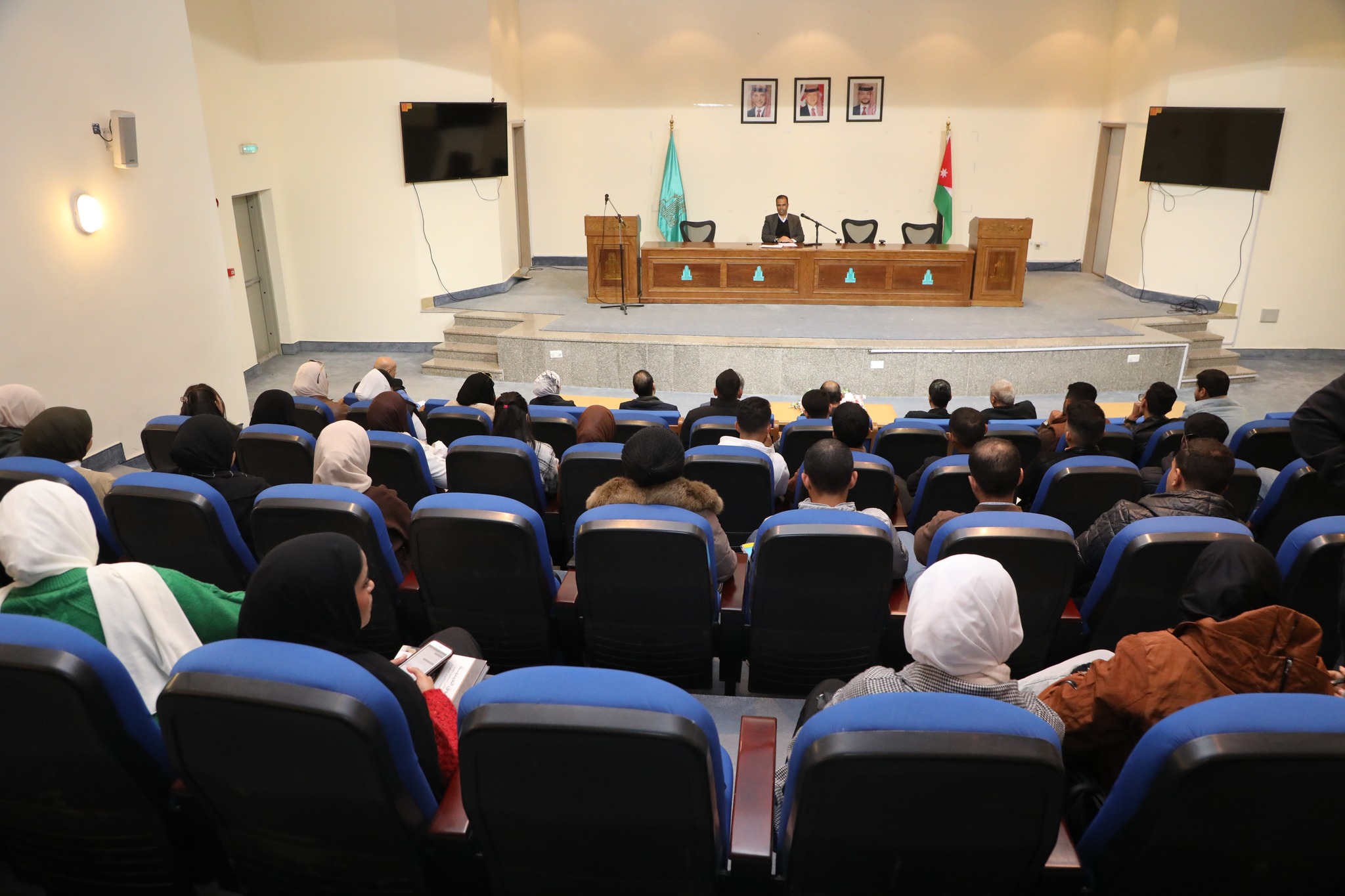
The Faculty of Law at the university organized a specialized scientific seminar entitled "Criminal Responsibility in Crimes Committed by Artificial Intelligence," lectured by Assistant Professor of Criminal Law, Dr. Qassem Al-Aoun, in the presence of faculty members and students of the college, to discuss emerging legal challenges, in the Hassan Bin Talal Amphitheater at the Faculty of Engineering at the university.
Dr. Qassem Al-Aoun spoke at the seminar, beginning by defining artificial intelligence as an attempt to simulate human intelligence, explaining that the difference between them lies in the dependence of artificial intelligence on inputs of information and software, while human intelligence is characterized by creativity, speed, and emotions. Al-Aoun pointed out that this development imposes restrictions and conditions that necessitate the need to reconcile the technical and legal fields.
Dr. Al-Aoun stressed that the issue of criminal responsibility requires specific measurement and context, indicating the importance of establishing intentional criminal responsibility for both the producer and user of artificial intelligence. To achieve this, he called for strict controls on the producer and the user, with the introduction of new legal concepts applied within simultaneous standard and ethical controls, noting that the expected risks require urgent legislative amendment, because the principle of criminal responsibility always needs clear legislative intervention.
In the context of national legislation, the lecturer confirmed the absence of an explicit legal text that helps in addressing criminal responsibility in Jordanian legislation, explaining that the general rule requires that a person expect the occurrence of the result. Dr. Al-Aoun also explained the existence of legal justifications and conclusions that justify not holding artificial intelligence criminally responsible at the present time, highlighting the difference between the results of civil and criminal liability and the difficulty of applying the standard rule criminally to the machine.
Al-Aoun warned that artificial intelligence may have a high ability to escape punishment by 2030 if the introduction of information into it continues without controls, which may allow it to dominate humans. Dr. Al-Aoun concluded his speech with a decisive recommendation, calling for the necessity of bringing together legal expertise in administrative and criminal law, to have the final say in setting the framework necessary to limit the spread of artificial intelligence in a way that is safer for society.
Dr. Barjas Al-Shawabkeh introduced and moderated the lecture, during which there was an extensive discussion and dialogue between the lecturer and the attendees about the criminal responsibility of artificial intelligence.
